
FRDC Release and Transfer Paths
Fulton Reception and Diagnostic Center is a Missouri Department of Corrections institution. It receives people entering the state system, assesses them, and processes many for transfer. A departure from FRDC therefore does not carry the same meaning as a bond release from Callaway County Jail. The person may move to another MODOC institution, enter field supervision through parole or conditional release, receive another authorized placement, or reach final discharge.
The key record is the statewide MODOC event and assignment history. An active institutional assignment points to continued confinement. A field or Probation and Parole assignment can show that the person is outside prison while still under state control. Final discharge ends department supervision. A missing active result is not enough because the public offender search expressly excludes discharged people. For the complete Callaway custody-system comparison, use the Callaway County release search and match each record to its actual custodian.
Confirm an FRDC Release
Start with the MODOC Offender Web Search. Search by DOC ID when it is known because that permanent number is safer than name alone. The search is for active people sentenced to or supervised by MODOC. It is not a list of everyone once booked in Callaway County, and it is not a historic directory of every fully discharged person.
- Complete the search form and enter the DOC ID or the exact name.
- Confirm identity with the cause number, sentencing county, and offense data.
- Read the active place as an institution or field supervision assignment.
- Compare minimum, maximum, sentence, and event dates without treating them as synonyms.
- Check Case.net for sentence changes, revocation, or consecutive terms.
- Request the event and location history when the public result is incomplete.
“Sentence-I Minimum Release Date” is the calculated minimum date on an active sentence and is defined as the conditional-release date. It is not a guaranteed door time. The maximum date is a different sentence boundary. A Parole Board presumptive date is also subject to conduct, programming, a suitable release plan, sentence changes, and later review. The actual transition belongs in the event history and facility record.
Note: A positive MODOC field assignment can mean community placement under supervision, not final discharge from state authority.
FRDC Release Records Contact
FRDC staff can address institution-specific custody questions within disclosure limits. For broader public offender questions, MODOC lists 573-526-2695 and constituentservices@doc.mo.gov. A durable record request goes to the Office of Director Sunshine channel at OD.SunshineRequest@doc.mo.gov. Include the DOC number, court cause number, relevant dates, and the exact records sought.
1393 State Route O
Fulton, MO 65251
573-592-4040
Missouri Department of Corrections
Ask for custody and release chronology, actual transfer or release date, location history, custody-completion reason, supervision start or end, and the final-discharge event if one exists. A releasable Notice of Board Action uses the Parole Board Sunshine channel. Some medical, security, or privileged Board and supervision material can be withheld. Request any separable public fields and the legal basis for a denied portion.
FRDC Diagnostic Custody Records
MODOC describes FRDC as a minimum and diagnostic institution on a roughly 90-acre site. It was built in 1986. Its main purpose is assessment and processing at the front of a state sentence, not service as the local county jail. That function makes location data especially important. A short FRDC assignment may be the expected intake stage before another institution becomes responsible.
The public MODOC record documents DOC number, cause number, sentence counties, offenses, sentence dates, minimum and maximum fields, completion flags, and event concepts in its Sunshine data dictionary. Not every internal field appears on every friendly search result. Use a public result to locate the right person, then use the nightly data or a focused request to close the gaps.
FRDC Release Campus Distinction
FRDC sits near the Callaway County Jail, but the two facilities belong to separate governments and separate record systems. The county jail’s 48-hour list can show that a local booking ended. It cannot establish what happened within MODOC after a state transfer. FRDC’s state assignment can show the receiving institution, yet a later disappearance from FRDC alone still does not prove release.
This is the distinctive local angle of the State Road O campus. A person can move a short geographic distance while making a major legal transition from county custody to a state sentence. The correct chain is: county booking record, court commitment, MODOC receipt event, FRDC diagnostic assignment, and the next institutional or field placement. Match the booking number, cause number, DOC ID, and dates at each step.
A community transition needs more. Look for a release event, Board action when relevant, and a field assignment or completed record consistent with the claimed status. Parole and conditional release place a person outside prison under supervision. Final discharge is the stronger end point. Neither should be inferred from the map location alone.
FRDC Discharge Record Gap
The friendly offender search excludes discharged offenders. That design creates a common false conclusion: no result is treated as proof of release. It is only a search limit. MODOC’s Sunshine data page describes a nightly working file that covers people who are or have been supervised, with data reaching back decades. The file is organized by charge, not one row per person, and MODOC warns that working data may be incomplete.
| Field | Use in an FRDC release check |
|---|---|
| DOC ID | Maintains the identity match |
| Cause number | Links the sentence to Case.net |
| Completed flag | Supports sentence or supervision completion |
| Minimum date | Shows the calculated conditional-release date |
| Maximum date | Shows the sentence boundary field |
Match the permanent identifiers before drawing any conclusion. A completed flag with compatible dates and a court disposition is stronger than a missing active-search result. When the exact event matters, request the release or final-discharge record from MODOC.
View the FRDC Record Source
The official FRDC family page illustrates the diagnostic and transfer role used in this release analysis.
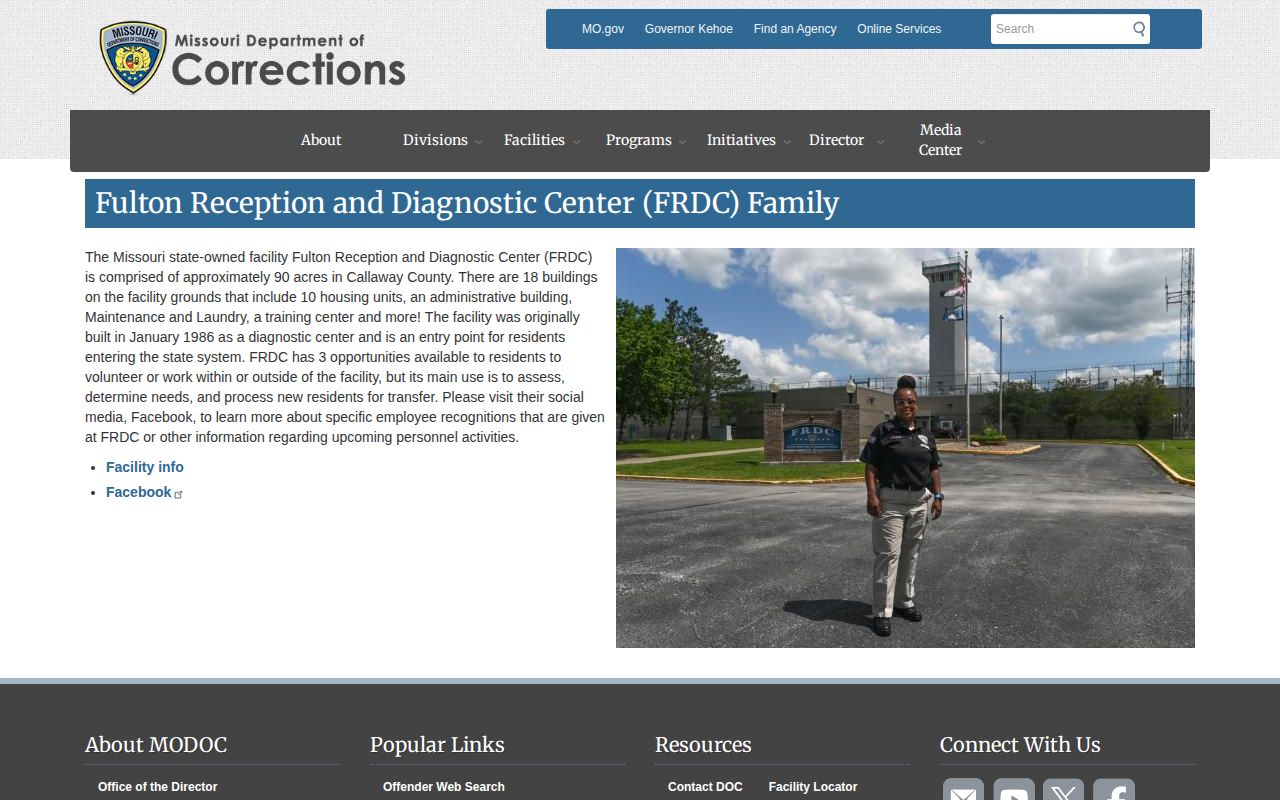
The source view reinforces why an FRDC departure must be checked against the next MODOC assignment rather than treated as a county release.
FRDC Parole Release Evidence
A parole hearing does not mean that an FRDC resident will leave soon. Missouri’s process can produce a presumptive parole date, a denial tied to a conditional or maximum date, or a later reconsideration. Even a presumptive date remains subject to release readiness, conduct, required programming, sentence changes, and approval of the release plan. The institutional parole office is the proper source for a confined person’s specific date and home-plan questions.
When parole is the claimed FRDC release mechanism, seek the Notice of Board Action, the effective event, and the next assignment. A field assignment supports release from prison with supervision. It does not show final discharge. The supervising office may be District 26 only if that office owns the approved plan. A Callaway conviction or an FRDC stay does not force the field assignment to remain in Fulton.
FRDC Sentence Date Limits
Missouri sentence fields require careful labels. The conditional-release calculation, maximum expiration, and Board presumptive date answer different questions. Consecutive sentences, jail credit, a modified judgment, revoked probation, statutory minimums, required treatment, and Board action can move the operative date. Some records use special maximum-date values for life or indeterminate cases, so a raw number may require agency interpretation.
Use Case.net to obtain the judgment and determine whether terms run together or one after another. Compare that order with the MODOC cause number and sentence fields. Then check the event close to the expected date. Never transplant a county jail bond rule or local time-served calculation into the state-prison record. FRDC administers a state placement under MODOC authority.
Note: Date every saved FRDC result because active assignments and calculated sentence fields can change after the first search.
FRDC Transfer Verification
A transfer finding should name the receiving institution or agency. If the active search changes from FRDC to another MODOC institution, that is direct evidence of continued state custody. If it changes from FRDC to a field office, examine the release event and supervision effective date. If the person vanishes from the active search, inspect the completed flag and request the historic event rather than presuming discharge.
The strongest file keeps the DOC ID, cause number, old and new assignments, and effective dates together. An alert from MOVANS or another status system can be a useful prompt, but it is not an authenticated discharge record. When the next custodian is federal, county, or another state, follow that receiving system as well.
Public Record Search
Sponsored Results