
Callaway Parole and Probation Compared
Parole and probation both allow a person to live outside a prison, but they begin under different authority. Probation is a sentence or case outcome ordered by a court. It may be imposed instead of prison or after a sentence is suspended. Parole is a release from a Missouri prison authorized by the Missouri Parole Board before the sentence reaches its final end. Conditional release is set by statute and is also supervised in the community. In Callaway County, the Missouri Department of Corrections Division of Probation and Parole performs field supervision for all three paths.
The distinction matters when reading a record. A Callaway court docket can show probation, revocation, or satisfaction. A MODOC record can show an institutional assignment, a field or P&P assignment, sentence events, and completion data. An active field assignment supports that the person is outside prison and still supervised. It does not show final discharge. Section 217.690, RSMo, states that a parolee remains in the department's legal custody and must follow Board orders.
| Status | Who orders it | Best verification path | How it ends |
|---|---|---|---|
| Probation | Sentencing court | Case.net, MODOC search, assigned P&P office | Court completion, early discharge, or expiration |
| Parole | Missouri Parole Board | MODOC assignment, Board action, assigned P&P office | Final discharge or sentence expiration |
| Conditional release | Statutory framework and Board administration | MODOC minimum-release and event data, assigned office | Final discharge after the supervision term |
- Discharge
- The event that ends MODOC supervision, not merely the day a person leaves an institution.
- Absconder
- A supervised person who leaves an approved residence without permission in order to avoid supervision.
- Field assignment
- A MODOC placement with a probation and parole office instead of a prison institution.
- Revocation
- An official action that cancels community supervision and may return the person to custody.
Verify Callaway Post-Release Supervision
Begin with the person's permanent DOC number when it is known. The MODOC Offender Web Search accepts a DOC ID or a name, but its public interface covers active offenders and expressly excludes discharged people. Match the full name and DOC ID before relying on an assignment. An institution name means state confinement. A P&P or field location can mean physical release with continuing supervision. A missing result cannot prove that supervision ended because a discharged record is intentionally outside the friendly search.
Callaway County supervision should then be checked against the court and field office. Case.net can show a probation order, later violation, revocation, satisfaction, or other court action. The field office can confirm only information that is public, so provide the DOC ID and ask whether District 26 is the right assigned office. For a durable answer, request the supervision start and end dates, final-discharge event, or releasable Board action from MODOC.
- Search MODOC by DOC number if possible. If only a name is available, compare all public identifiers before selecting a result.
- Read the active assignment. Separate an institution from a P&P field office or community supervision placement.
- Open Case.net and read the Callaway County docket in date order for probation, warrants, revocation, or satisfaction entries.
- Contact the assigned P&P office with the DOC ID and ask for releasable confirmation of active supervision.
- If the person is absent from the active search, use MODOC Sunshine data and request the completion or final-discharge event.
The broader Callaway County released-inmate search and records path helps distinguish a county-jail release from a MODOC community placement.
Note: Match the DOC number and record date because names, assigned offices, and supervision status can change during the same sentence.
Callaway Supervision Through District 26
District 26 serves Callaway and Audrain Counties. The current MODOC directory places the Fulton Community Supervision Center and P&P office at 1397 State Road O, Fulton, MO 65251, with telephone 573-592-6840. An older official district guide listed weekday hours and a different main number. Use the current directory number and verify hours before visiting. The office is the practical local contact when an active MODOC result assigns a person to District 26.
The MODOC facilities map shows the local supervision and institution context around Fulton. The successful manifest capture below preserves that official view.
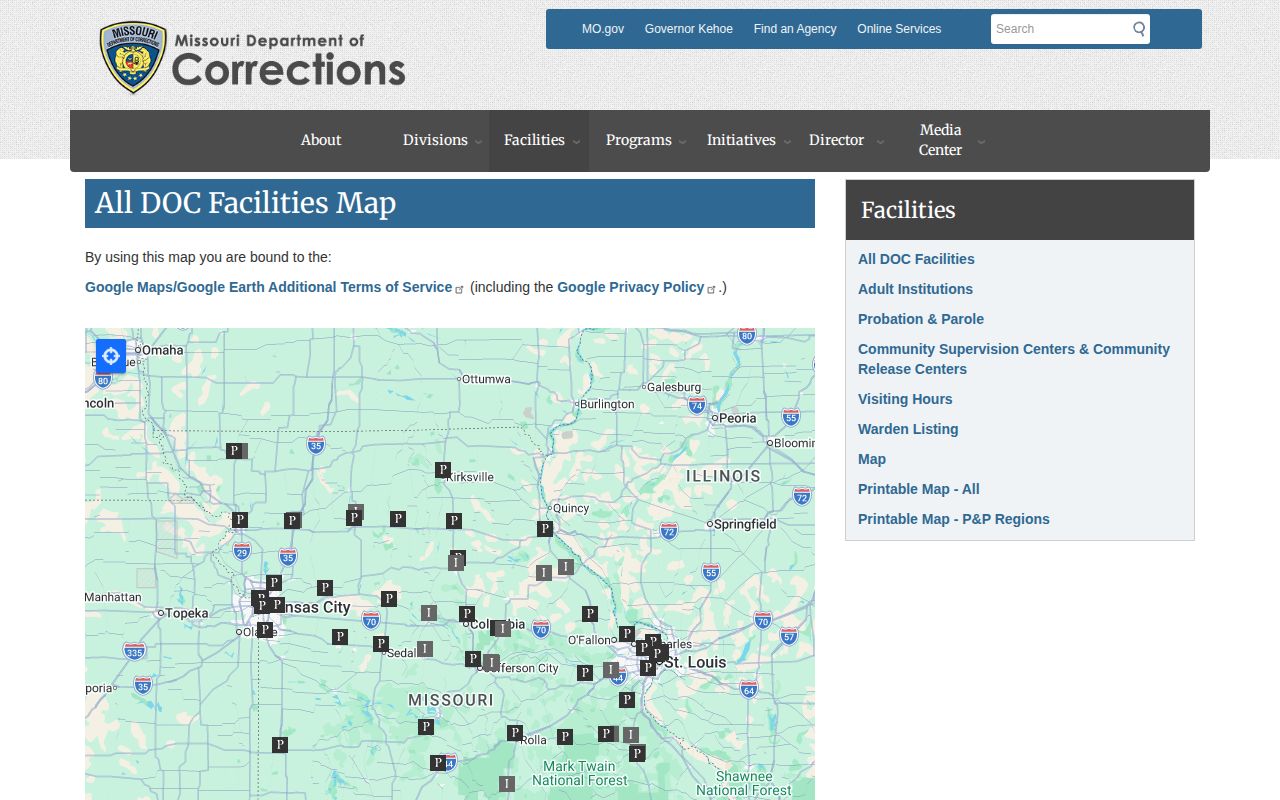
The map helps prevent a common mistake. FRDC is an institution and diagnostic transfer point, while District 26 is a field-supervision office. Movement from one to the other can mark a release to supervision, but only the person's assignment and event record confirm it.
District 26 / Fulton CSC
Missouri Division of Probation and Parole
1397 State Road O
Fulton, MO 65251
573-592-6840
Verify office hours before visiting.
Fulton Supervision After Callaway Release
The Fulton Community Supervision Center adds a distinctive residential layer to Callaway County parole and probation. MODOC describes it as an all-female residential supervision program. It is not a county jail, and it is not the same as ordinary field reporting. A resident is outside prison but remains under a supervision plan, with the referring probation and parole officer continuing to supervise the case.
Leaving the center has more than one possible meaning. It may reflect successful program completion, a move approved within the supervision plan, another placement, or an enforcement action. It is not automatically a final discharge. Check the active MODOC assignment, ask the referring P&P office for releasable status, and look for an official completion or discharge event before describing the supervision as over.
The official Fulton Community Supervision Center page documents the residential program and its role.
This program detail explains why an address change or departure from the center is only one point in the broader Callaway County supervision record.
Note: District 26 serves two counties, so a Callaway conviction does not by itself prove that the Fulton office is the current assignment.
Callaway Parole Board Records
The Missouri Parole Board decides parole under Section 217.690. Its guidelines and time-to-serve material do not promise release. No official person-by-person public hearing calendar or name-searchable decision database was located in the research. That gap matters. The general Board page should not be presented as a calendar for a named person, and eligibility should not be described as an approved release.
Board rules generally schedule an eligibility hearing about four months before minimum eligibility, subject to exceptions. MODOC says the decision normally takes eight to twelve weeks. Possible results include a presumptive parole date, denial with the conditional or maximum release date, or denial with a future reconsideration hearing. A later release-readiness review can approve, change, cancel, or reschedule a date. The written notice is routed through the Institutional Parole Officer.
The Missouri Parole Board page is the official source for current rules and contact channels.
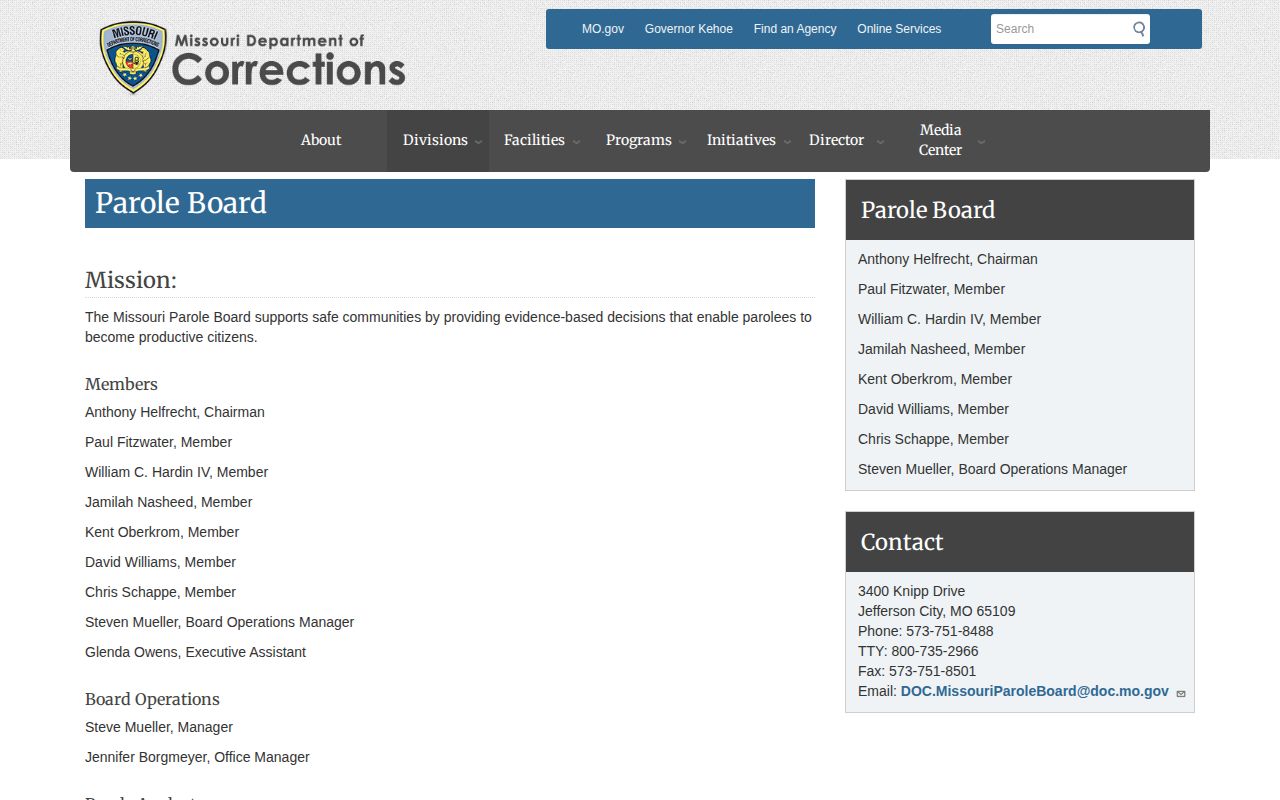
The capture supports the distinction between general policy and a case-specific action. A releasable Notice of Board Action may be requested through ParoleBoard.SunshineRequest@doc.mo.gov. Some Board and P&P working material is privileged under Section 549.500.
Callaway Supervision Violations and Absconders
Conditions are the rules attached to probation, parole, or conditional release. They may include reporting, approved residence, programming, and other case-specific directions. The governing order and supervising officer are the right sources for the exact terms. A violation does not always produce the same response. It may lead to added direction, a hearing, a warrant, revocation, or another official action, depending on authority and facts.
An absconder is not just someone whose address is unknown. Section 217.703 describes the term for earned-compliance purposes as a supervised person who leaves the residence without permission to avoid supervision. No earned compliance credit accrues during an absconder or violation period. The safe verification route is the assigned P&P office or law enforcement. Members of the public should not try to locate or apprehend a person based on a status label.
Case.net can contain a warrant, probation violation, revocation, or later recall entry, but a court docket is not a live physical-custody locator. MODOC assignment data and official confirmation supply the supervision side. Missouri VINE can provide authorized custody or court-event alerts, yet a notification remains a lead rather than a certified supervision record.
Note: A warrant or violation entry should be read with its date because a later recall, disposition, or reassignment may change the status.
Property Paths After Callaway Release
Callaway County property handling offers a practical clue about whether a jail departure was a community release or a transfer. The sheriff says inventoried property is sealed. When a person transfers to MODOC or another jail, remaining property accompanies that person and is not kept at the Callaway jail. Evidence follows a different path and requires contact with the Evidence Custodian after release.
The sheriff's property-intake information explains the intake and sealed-property process. Transfer of personal property with a person supports movement to another custodian, not final discharge. By contrast, a post-release evidence inquiry concerns items held as evidence and does not establish whether probation or parole remains active.
This local distinction should be checked against the release or movement record. Property handling alone cannot determine status. For a Callaway County jail episode followed by MODOC supervision, match the county release disposition with the state assignment and the District 26 record when that office is named.
Ending Callaway Post-Release Supervision
Final discharge ends supervision. It differs from release from prison, departure from the Fulton center, or transfer between field offices. MODOC defines an ex-offender as a person released from all department supervision. That is the clearest conceptual line. When a public search still shows an active field assignment, the person has not reached that final status even if living in the community.
Missouri allows earned compliance credits for eligible, compliant periods on probation, parole, or conditional release. Section 217.703 generally provides thirty days for each full compliant calendar month, subject to exclusions and pauses. Those credits can advance final discharge from supervision. They are not prison good time and do not change the fact of the earlier institution release. MODOC directs calculation questions to the supervising officer and states that there is no formal appeal from the credit calculation.
Because the active public search excludes discharged offenders, an absent result is not enough. Use the MODOC nightly Sunshine file to match the DOC ID, cause number, completed flag, and date fields. Then request the final-discharge or event record if a durable answer is needed. This path also helps distinguish a true discharge from a spelling problem, delayed update, or record outside the public interface.