
Callaway Release Dates Are Distinct
Missouri uses several date fields that answer different questions. The Sentence-I Minimum Release Date, stored as the MODOC Sunshine field $PC, is the calculated minimum date on an active sentence. The MODOC glossary defines that term as the conditional-release date. The Sentence Maximum Release Date, stored as $PD, marks the maximum release or expiration boundary. A presumptive release date is set by the Missouri Parole Board under its rules. None of these is the exact time a facility door opens.
The distinction is vital for a Callaway County case. The minimum field concerns a statutory calculation. The maximum field concerns sentence expiration and can include special values for life, indeterminate, interstate, or assessment records. A presumptive date reflects a Board decision that still depends on conduct, required programming, an acceptable release plan, and later review. The actual event belongs in the custody history, institution record, or county jail release sheet.
- Minimum release date
- MODOC's calculated conditional-release date for an active sentence.
- Maximum release date
- The sentence expiration boundary, subject to the meaning of any special field value.
- Presumptive release date
- A date set by the Parole Board that remains subject to readiness and later review.
- Actual release event
- The recorded custody change showing release, transfer, parole, conditional release, or discharge.
Find a Callaway Projected Date
Start with the last known custodian. A person awaiting trial at Callaway County Jail has no fixed sentence date. Check Case.net for bond orders, warrants, disposition, or a later sentence, and ask jail staff about current custody. For a local sentence, the judgment, credited time, and jail administration control the calculation. The public Callaway released feed shows actual timestamps after release, not projected dates.
A person sentenced to Missouri prison follows the state path. Search the MODOC Offender Web Search by DOC number when possible. Read the institution or field assignment first, then inspect sentence and date information without relabeling a minimum date as guaranteed. Reconcile the result with the Callaway court judgment, especially when terms are concurrent, consecutive, amended, or affected by probation revocation.
- Identify whether the person is pretrial, serving a county sentence, or serving a MODOC sentence.
- Obtain the judgment and sentence from Case.net or the Callaway Circuit Clerk and note the offense date and exact statute.
- For state custody, search by DOC ID and record the active location, minimum date, maximum date, and any completion information shown.
- Check Section 558.019 and any offense-specific law for a mandatory minimum, then read the relevant Board action.
- Recheck the assignment near the expected date and confirm the final event with the institution, field office, or a targeted records request.
The Callaway County release-record path explains how to confirm the later actual event when the projected date arrives.
Note: A pretrial release depends on bond and court authority, so a sentence-based minimum date should never be assigned to that jail status.
Callaway MODOC Release-Date Fields
MODOC's public search is designed for active people who are confined or supervised. It expressly excludes discharged offenders. A current institution placement means the person remains in state confinement. A P&P field assignment can mean the person has left prison on probation, parole, or conditional release but remains supervised. No active result may mean final discharge, yet it may also reflect a search mismatch or another data limit.
The public result does not expose every internal MOCIS field in every case. MODOC's Sunshine data dictionary documents the durable DOC number, court cause number, sentencing county, offense information, sentencing date, completed-sentence flag, minimum date, maximum date, and event concepts. Match DOC ID and cause number rather than relying on a name alone. One person can produce multiple rows because the nightly file is one row per charge.
| Field | What it answers | What it does not prove |
|---|---|---|
| DOC ID | Durable identity within MODOC | Current custody by itself |
| $PC minimum date | Calculated conditional-release date | Guaranteed physical release |
| $PD maximum date | Maximum release or expiration boundary | Earliest community date |
| Completed flag | Whether the linked sentence row is completed | The reason for every custody movement |
| Event/effective date | Timing of a recorded MODOC action | Meaning without its event type |
The MODOC Sunshine field page supplies the official field descriptions and records-request channel.
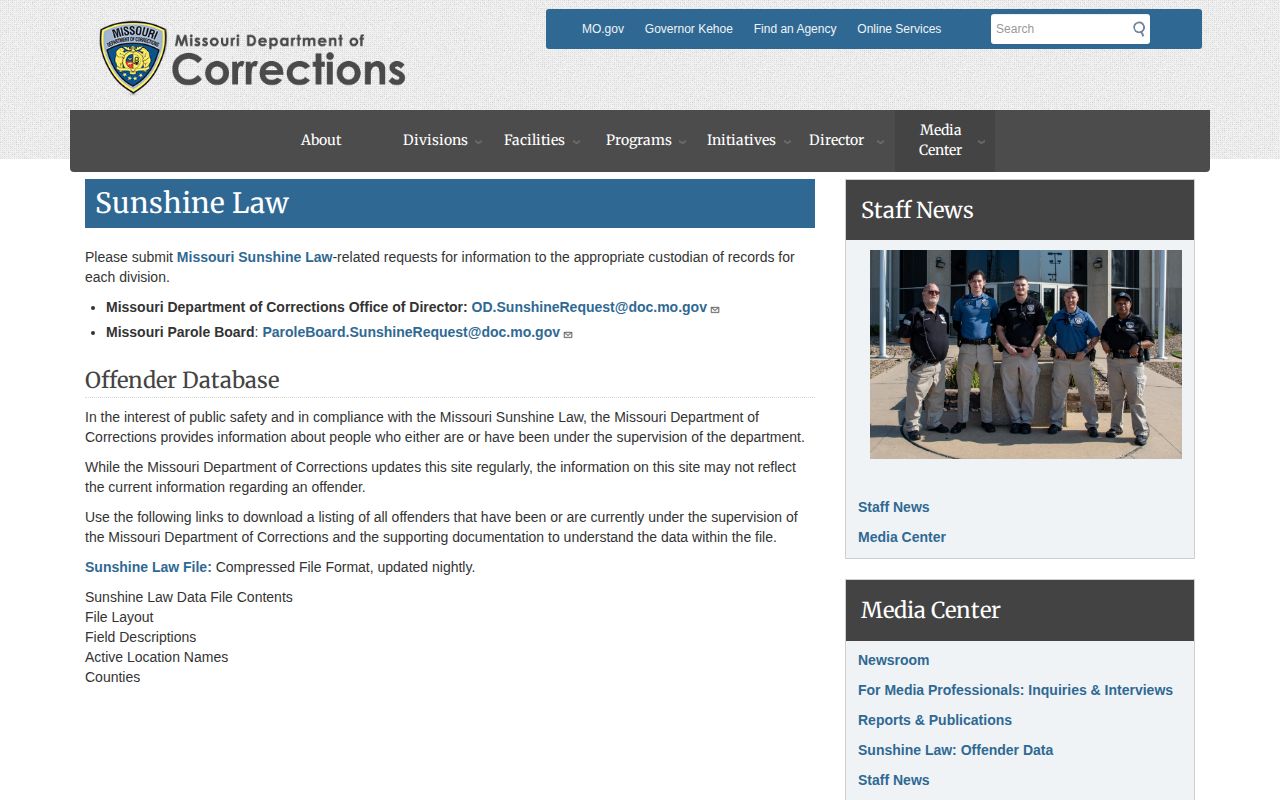
The captured page is especially useful when a public result omits a discharged person or does not display each calculation needed to interpret the sentence.
Note: Preserve the field label and access date because minimum, maximum, presumptive, and actual dates have different official meanings.
Callaway Conditional Release Calculations
Section 558.011.4, RSMo, sets a general conditional-release split for term-of-years felonies other than dangerous felonies and fourth-or-subsequent DOC remands. For terms of nine years or less, the conditional-release portion is one-third. For terms over nine through fifteen years, that portion is three years. For terms above fifteen years, it is five years. The prison term is the remainder, and conditional release is a supervised phase.
This arithmetic is only a starting framework. It is not a public calculator for every Callaway County sentence. Consecutive terms, credited jail time, offense-specific minimums, amended sentences, revoked probation, required treatment, and Board action can change the operational date. Section 558.011.5 also permits the Board to extend conditional release, after the prescribed petition and hearing process, as far as the entire sentence.
Read the offense and offense date from the judgment before applying current law. Statutes and definitions can change over time. The court establishes the imposed terms and whether they run at the same time or one after another. MODOC then applies those terms with the governing release statutes and its event history. A date should be tied to a source and the date it was checked.
Callaway Minimum Prison Terms
Section 558.019, RSMo, is Missouri's principal minimum-prison-term authority. Under the current text, a person committed to DOC for a dangerous felony as defined by Section 556.061 generally must serve 85 percent of the sentence, or reach age seventy after serving at least 40 percent, whichever occurs first. Other prior-commitment rules can impose 40, 50, or 80 percent minimum terms.
The phrase minimum prison term means time before eligibility for parole, conditional release, or another early DOC release. It is not a statement that every Missouri prisoner serves 85 percent. The conviction statute, offense date, dangerous-felony definition, prior commitments, and sentencing papers must all be checked. Offense-specific law may create a different mandatory period. This framework also does not apply to a Callaway County bond release from pretrial detention.
Parole Board procedures discuss an administrative time-credit date calculated from conditional release. Important ineligibility categories include dangerous-felony cases under the 85-percent rule, certain 80-percent cases, nonparoleable offenses, extended conditional release, required-program failures, and violation returns. The current Board rules must be used for the exact category. No credit should be promised from a general description.
Note: A percentage is an eligibility constraint, not an exact release appointment, and later Board or custody events still control the outcome.
Callaway Credits and Final Discharge
Missouri credits use similar words for different legal phases. Institutional time credit should not be reduced to a simple number of good days automatically removed from a prison term. Its use depends on Board procedures, eligibility categories, conduct, required programs, and other case facts. A date produced within that framework remains subject to agency review and should be checked against the sentence record.
Earned Compliance Credits under Section 217.703, RSMo, apply after an eligible person is on compliant probation, parole, or conditional release. They generally accrue at thirty days for each full compliant calendar month and can lead to final discharge when statutory conditions are met. No credit accrues during an absconder or violation period. These credits shorten supervision. They are not prison good time and do not establish the day a person first leaves prison.
A Callaway County record can therefore contain several meaningful dates: the state prison release, the start of District 26 or another field assignment, a later earned-credit calculation, and final discharge. Each should be labeled by its actual event. Calling all of them a release date hides whether the person remains under MODOC control.
Why Callaway Release Dates Change
A projected date is a calculation built from facts that can change. Some changes correct the sentence itself. Others arise from behavior, programming, another custodian's claim, or Parole Board review. The correct response to a moved date is to identify the newer official source and preserve the earlier source date. A claimed hold or lost credit should not be guessed from a delayed release alone.
| Factor | Possible effect | Where to verify |
|---|---|---|
| Corrected or consecutive sentence | Changes the term structure or end point | Court judgment and MODOC sentence data |
| Jail-credit reconciliation | Adjusts credited time before or during DOC custody | Court and MODOC calculation record |
| Required program not complete | Can delay readiness or conditional release | Institutional parole office and Board action |
| Board extension or review | Moves or cancels a presumptive or conditional date | Notice of Board Action |
| Detainer or hold | May transfer the person to another custodian | Custody movement and receiving-agency record |
| Violation or return | Stops eligible credit or changes supervision status | P&P, court, and MODOC event history |
| Release plan not approved | Can delay a planned community transition | Institutional parole office |
A detainer is a request or hold from another authority. It may cause a transfer after Callaway or MODOC custody ends, so the first agency's release event does not necessarily mean return to the community. Follow the receiving custodian and record the disposition.
Missing Callaway Discharge Records
Missouri's discharged-record gap is central to a projected release lookup. The friendly MODOC Web Search expressly excludes discharged offenders. As a result, a person can disappear after all supervision ends even though the historic sentence and dates still exist in agency data. A no-result cannot be turned into a release or discharge finding.
The nightly MODOC Sunshine file covers people who are or have been supervised and can reach back to earlier state records. It includes permanent DOC ID, cause number, sentence-completion information, and minimum and maximum fields. Since it is working data, MODOC warns that it may be incomplete or inaccurate. It also uses one row per charge, so several lines may belong to one person.
Correlate the DOC ID, Callaway cause number, sentencing county, completed flag, and relevant dates. Then request the actual release, transfer, or final-discharge event when the distinction matters. This sequence is stronger than assuming that an active-search absence proves the projected date arrived as planned.
Note: A completed sentence row is stronger historical evidence than a name-only no-result, but the release event remains the best confirmation.
Callaway County Jail Date Limits
County sentences use a different calculation from Missouri prison sentences. Callaway's official public release feed provides actual release timestamps after a jail episode ends. It does not display a projected county date. The sentencing order, credited time, and jail administration control a local term. MODOC's $PC and $PD fields should not be imported into a county-only sentence.
No official Callaway County Jail good-time policy or weekend-adjustment rule was located. No fixed release hour was found either. Those absences prevent a reliable public formula. Ask the jail records unit for the sentence computation tied to the specific booking, and use the court judgment to confirm the imposed term. If the record says transfer to FRDC, another jail, a federal agency, or ICE, that date ends Callaway custody but does not establish community release.
For state release alerts, the separate VINELink inmate check explains current Missouri notification channels. An alert is useful near an expected event, but the institution, field assignment, or official release record remains the confirmation source.